BERTrend: How Topics Emerge, Evolve, and Disappear
“Which topics are gaining attention right now?” “Is that interest growing—or already declining?” “And which topics are likely to matter next?” Identifying topics in text is useful, but it is not enough when the goal is to understand how public discourse changes over time. Topics appear, grow, peak, and eventually fade. To capture these dynamics, we must look beyond static topic modeling. Traditional topic modeling (such as LDA or BERTopic) focuses on uncovering what is being discussed at the current moment. BERTrend, however, reveals how those topics shift over time.
Understanding How Topics Change
A common approach to temporal topic analysis has been to classify documents into topics and then track topic frequency over time.
While this can show increases or decreases in attention, it often struggles to detect emerging topics—especially when they start small.

Some researchers perform topic modeling separately for each time slice, but this requires manually comparing similar topics across time, determining whether they represent continuation or new emergence. This process is time-consuming and subjective.
BERTrend (BERT + Trend Detection), introduced in 2024, addresses these limitations. It links BERTopic results across time based on semantic similarity, then categorizes topic trajectories into signals such as: - Strong - Emerging - Declining - Inactive Rather than stopping at topic classification, BERTrend models the full lifecycle of a topic: emergence → growth → spread → decline → disappearance.

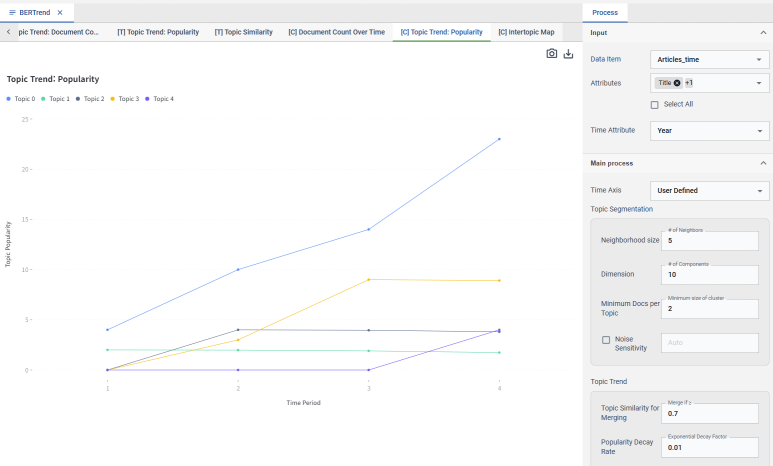 BERTrend topic popularity results in NetMiner
How BERTrend Works

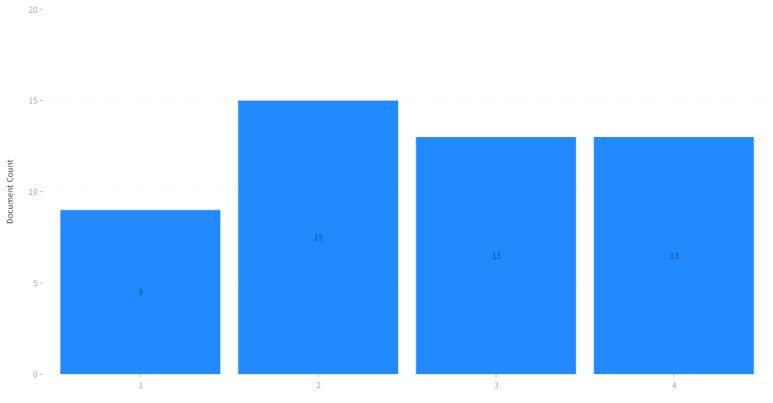
1. Time-based document segmentation
Documents are grouped by time units (year, quarter, month, etc.). This becomes the basis for identifying which topics existed during each period.

2. Topic modeling for each time slice
BERTopic is applied to each time segment independently, enabling detection of early-stage topics that may have been missed in global modeling.
3. Linking topics across time
For each time slice, the topics generated are compared with topics from the previous period. This comparison is performed using semantic similarity—specifically, the cosine similarity between topic embeddings. If the similarity value exceeds a predefined threshold (default: 0.7), the two topics are considered part of the same evolving topic and are connected in a temporal sequence. If the similarity falls below the threshold, the topic is treated as newly emerged rather than a continuation of an existing one. This step is key because it removes the need for manual labeling or comparing topic names across time. Instead, BERTrend uses embedding-based semantic representations to automatically determine whether topics across timesteps are meaningfully related.
※ A topic embedding represents the semantic meaning of a topic, calculated as the averaged embedding of the documents belonging to that topic. It's vector-based representation of what the topic is about.
4. Popularity Tracking with Decay
Topic popularity grows when new documents appear and gradually decreases through exponential decay when interest fades.
5. Trend Signal Classification
Using a retrospective window, BERTrend analyzes popularity patterns and assigns one of four trend signals:
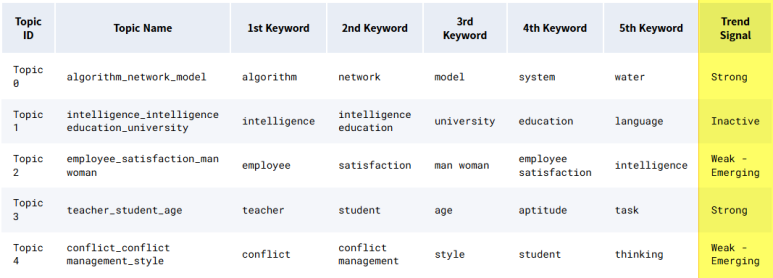

Strong: Stable and consistently high attention
Weak-Emerging: Rapidly gaining attention (slope > 0)
Weak-Declining: Attention decreasing (slope < 0)
Inactive: Attention decreasing (referred to as "Noise" in the original paper)
BERTrend goes beyond identifying what topics exist, it shows how topics evolve. It is useful for: - Detecting emerging research themes in academia and policy - Monitoring technological or market trends in industry - Analyzing public opinion dynamics in social and media datasets With BERTrend, topic modeling shifts from static interpretation to temporal insight, helping researchers understand not only what is being discussed, but what is changing, rising, and fading.