Who Really Holds the Power Over Social Responsibility on Construction Sites?
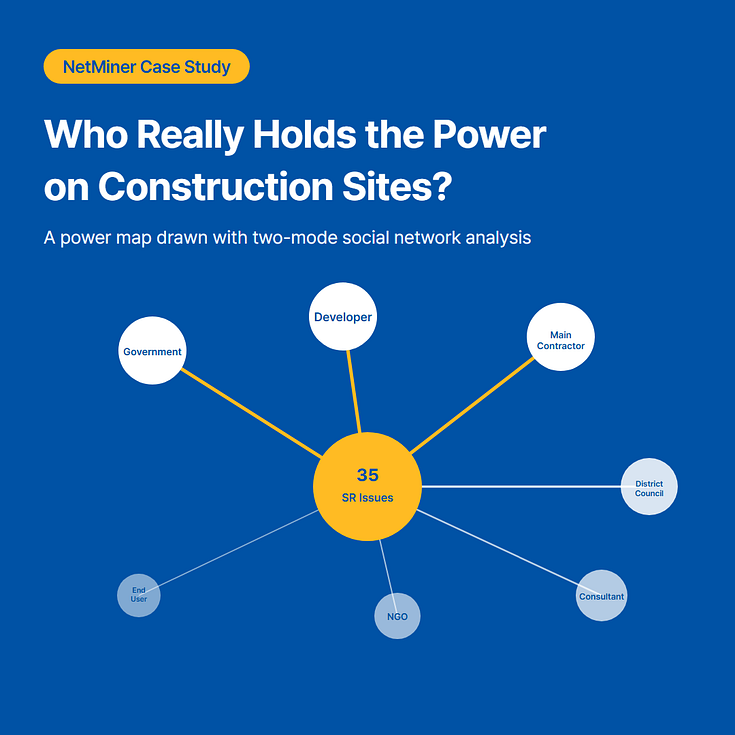
A single construction project brings together at least seven types of stakeholders: governments, developers, main contractors, consultants, NGOs, district councils, and end users. More than 35 social responsibility issues need attention, from safety to environmental protection to human rights to community relations. Yet when problems arise, everyone tends to say “that’s not my job.” So among all these issues, who actually has the power to solve them, and at what stage? This post introduces a study that analyzed responses from 89 Hong Kong construction industry practitioners using two-mode social network analysis to map out the power structure among stakeholders (Lin, Ho, & Shen, 2017).
Background
Responsibility Is Scattered, and Power Stays Hidden
Social responsibility (SR) in construction projects is still a relatively unexplored field compared to corporate-level CSR. Because a project is a temporary organization that exists only for a fixed period, participants can easily shift blame by claiming an issue “isn’t our responsibility.” Most existing stakeholder theories have focused on the influence of prominent players like developers and contractors, leaving the roles of less visible stakeholders, such as consultants, NGOs, local residents, and end users, poorly understood. On top of that, power doesn’t stay constant from the start of a project to its end; it keeps shifting. Few studies have quantified this dynamic flow.