The Synergy of Graph Intelligence: How AI and SNA Combine
Key Takeaways
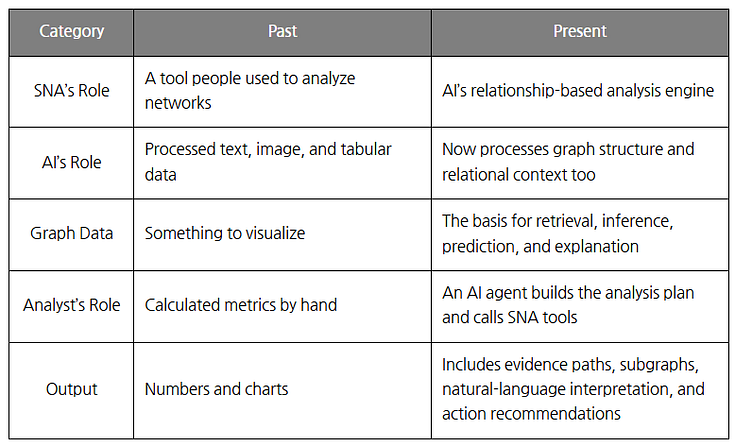
- Graph Intelligence is a system that combines AI’s language-understanding and automation capabilities with SNA’s ability to analyze relational structure — turning scattered data into connected knowledge, and delivering verifiable analysis and actionable decisions on top of that knowledge.
- AI produces answers and automation, SNA produces the evidence behind relational structure, and Graph Intelligence combines the two into analytical intelligence that is both explainable and actionable.
1. Why AI and SNA Need to Combine
In recent research, graphs have become the core data structure that lets AI understand real-world relationships, context, paths, influence, diffusion, and risk.
Graph machine learning (ML) is being applied to drug discovery, protein interaction prediction, knowledge-graph question answering, fraud detection, and social network analysis, and graph data management and graph ML are reinforcing each other across the entire graph data science pipeline. In particular, graph data cleaning, graph embedding, GNN performance, graph-based vector data management, and explainability are becoming increasingly interconnected. [Khan, A., Ke, X., & Wu, Y (2025)]
The convergence of AI and complex network science is also driving theoretical and practical innovation across natural science fields such as neuroscience, biomedicine, climate science, nonlinear dynamics, and robotics. [Hramov, A. E. et al. (2025)]
These recent trends show the direction in which AI and SNA are converging, and what that convergence is producing.