Do More Online Friends Lead to Deeper Gaming Immersion?
As smartphones and social media have become fully integrated into daily life, university students are now more connected to online friends than offline ones. Fast, continuous communication through social platforms spreads gaming-related information and activities in real time, making online relationships a key factor shaping gaming behavior. This post introduces a NetMiner-based analysis examining how the structure of online friendship networks relates to Internet Gaming Disorder (IGD).
Background
Do online friendship networks influence IGD?
University students are in a critical developmental stage where they establish identity, social roles, and future plans. Forming mature interpersonal relationships is central to this process. With the growing use of smartphones and SNS, students now interact frequently not only offline but across digital spaces. These online environments allow freer emotional expression, strengthening existing friendships but also creating numerous superficial ties. At the same time, university students have some of the highest levels of gaming time and are considered a high-risk group for IGD. IGD involves loss of control over gaming, continued play despite negative consequences, and disruption to everyday life. However, most previous studies have focused only on gaming time or negative outcomes, failing to explain how online relational structures shape IGD. This study therefore applies Social Network Analysis (SNA) to investigate how the structural position within online friendship networks relates to students’ IGD levels.
Core Idea
Why structural position matters
The key idea is that a person’s structural position in online friendships (their centrality) may influence IGD. Rather than simply counting the number of friends, the study examines: • who is connected to me (in-closeness) • whom I am connected to (out-closeness) • how central I am in the network overall These relational positions may shape exposure to gaming information, invitations to play, and interaction patterns that increase or decrease IGD.
Solution
1. Participants and Data Collection
Data were collected from 77 university students majoring in occupational therapy. Each participant provided:
• up to three online friends
• the frequency-based strength of each relationship
• their IGD score measured using the Korean Internet Gaming Disorder Scale (K-IGDS)
2. Network Construction and Centrality Measures
Based on the reported friendship ties, researchers constructed the online friendship network and calculated key centrality indicators:
• in-degree and out-degree
• in-closeness and out-closeness
• betweenness centrality
3. IGD Assessment
IGD levels were measured using the K-IGDS (27 items across 9 factors), where higher scores indicate greater risk of Internet Gaming Disorder.
4. Correlation Analysis
Lastly, correlations were examined between the network centrality measures and the participants’ IGD scores to identify how structural positions relate to IGD risk.
Result
Online relational structure influences gaming behavior
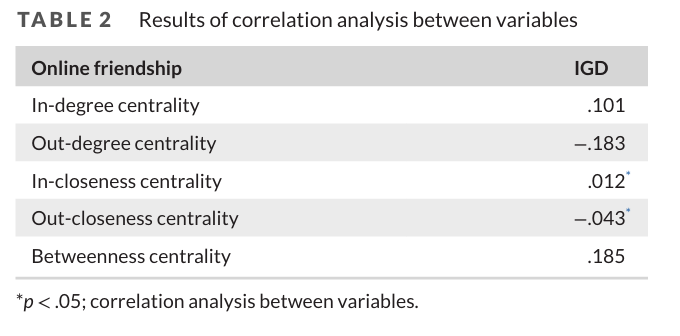

The study found a significant positive correlation between in-closeness centrality and IGD. Students who were located more centrally and received more incoming ties tended to have more gaming-related information and behaviors flowing toward them, increasing the likelihood of IGD.
In contrast, out-closeness showed a significant negative correlation with IGD. Students who could reach others more quickly and actively formed relationships appeared less vulnerable to IGD, likely due to broader social engagement beyond gaming.
These results highlight that IGD is not only an individual problem but also shaped by online relational environments.
The study provides empirical evidence that the structure of online friendships influences gaming behavior and underscores the importance of relationship-centered interventions, network analysis, and social support when addressing IGD in university populations.
NetMiner Team
netminer@cyram.com
References
[1] Son, S.-M., Oh, J.-S., & Jeon, B.-J. (2021). Correlational study between online friendship network and internet game disorder among university students. Brain and Behavior, 11(10), e2392. https://doi.org/10.1002/brb3.2392