BERTopic: Exploring Topics Through Semantic Understanding
Societal phenomena are becoming increasingly complex, and much of that complexity is captured in text — interviews, meeting minutes, academic papers, and news articles. However, reading through hundreds or thousands of documents to identify the main themes is nearly impossible. That’s where Topic Modeling becomes useful. Topic modeling is a technique that groups similar pieces of text together. For example, among thousands of news articles, if “AI,” “artificial intelligence,” and “machine learning” repeatedly appear, they are grouped under a single topic. As a result, topic modeling allows you to understand what themes or discourses exist in a dataset, and how certain topics emerge or fade over time, without having to read every document individually.
LDA and BERTopic
LDA (Latent Dirichlet Allocation) is one of the most widely used methods in topic modeling.

LDA groups words in a document to form topics and estimates the probability that each document belongs to a given topic based on word occurrence frequencies.
Source: Introduction to Probabilistic Topic Models paper by Blei et. al
LDA identifies topics by analyzing how frequently words appear in a document (the Bag-of-Words approach). This method is relatively simple and computationally efficient, making it especially effective for extracting topic structures from large text datasets. Because its mechanism is transparent and interpretable, it has long been favored by researchers.
However, LDA cannot capture the meaning or context of words. For instance, “AI” and “artificial intelligence” mean the same thing, but LDA may classify them as different topics simply because the words differ. (To solve this, terms like “AI” must be pre-processed and replaced with “artificial intelligence.”)
BERTopic, proposed by Maarten Grootendorst in 2022 through his paper “BERTopic: Neural topic modeling with a class-based TF-IDF procedure,” was introduced to overcome such limitations of traditional topic models. Based on BERT (Bidirectional Encoder Representations from Transformers), Google’s language model released in 2018, BERTopic converts sentence meanings into numerical vectors that computers can understand and then uses these vectors to identify topics.

BERTopic clusters documents based on semantic similarity and represents each cluster as a topic. In the figure above, each point represents a document — the closer the points, the more semantically similar the documents are. Each cluster is color-coded, and the topic name is shown at its center.
In other words, BERTopic groups similar sentences not by word frequency but by semantic similarity of entire sentences.
For example, although the expressions “AI” and “artificial intelligence” differ, BERT understands them as having similar meanings (close vectors). Because it has learned from massive amounts of contextual text.
Ultimately, LDA and BERTopic differ fundamentally in how they discover topics.
LDA splits text into individual words, calculates word frequencies, identifies topics, and then extracts representative words for each topic — in other words, word extraction → topic discovery.
BERTopic, on the other hand, computes semantic similarity between documents to identify topics, and only afterward extracts words from those topic-specific documents to define representative terms — topic discovery → word extraction.
In BERTopic, word extraction mainly helps humans interpret the discovered topics rather than being part of topic generation itself.
Thus, while LDA finds topics starting from words, BERTopic starts from meaning to find words — a reversal in approach that defines the shift from statistical to semantic topic modeling.
※ Source: Egger, R., & Yu, J. (2022). A topic modeling comparison between lda, nmf, top2vec, and bertopic to demystify twitter posts. Frontiers in sociology, 7, 886498.
How Does BERTopic Discover Topics?
BERTopic works by embedding (vectorizing) the semantic meaning of text, grouping sentences with similar meanings to identify topics, and then describing each topic through its representative keywords.
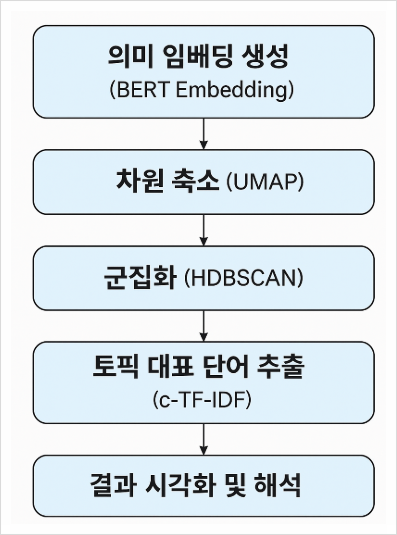
Document Embedding: Converting Meaning into Numbers
The embedding process is at the core of BERTopic and represents the meaning of text as numerical vectors.
The BERT language model interprets words within their context and encodes sentence meanings as vectors. Because BERT learns the relationships between surrounding words, expressions like “AI technology development” and “artificial intelligence innovation”—though phrased differently—are placed close together in vector space when they share similar meanings.
2. Dimensionality Reduction: Simplifying Complex Vectors
The embeddings produced by BERT are high-dimensional, often with hundreds of dimensions.
To make this information easier to analyze and visualize, dimensionality reduction techniques such as UMAP or PCA are applied. This process preserves the core semantic structure of the data while transforming high-dimensional embeddings into a form that can be effectively clustered. It serves as a crucial foundation for identifying topics in the next step.
3. Clustering: Grouping Similar Documents
Using the reduced data, BERTopic applies clustering algorithms like HDBSCAN or k-Means to automatically group semantically similar documents.
Each cluster represents a topic, while documents that don’t fit well into any cluster are labeled as outliers, preventing the creation of irrelevant or low-quality topics.
4. Extracting Representative Keywords: Explaining Each Topic
Once clusters are formed, BERTopic identifies key terms that best describe each topic.
It uses a class-based TF-IDF (c-TF-IDF) approach, treating each cluster as a single “virtual document” and calculating which words are most characteristic of that cluster. These weighted keywords then serve as representative descriptors for the topic.
Through these steps, BERTopic produces: ① Representative keywords for each topic ② Topic probabilities for each document ③ Topic similarity ④ Document clustering visualizations
These outputs allow researchers to explore text data not only by word frequency, but by semantic meaning and contextual relationships.

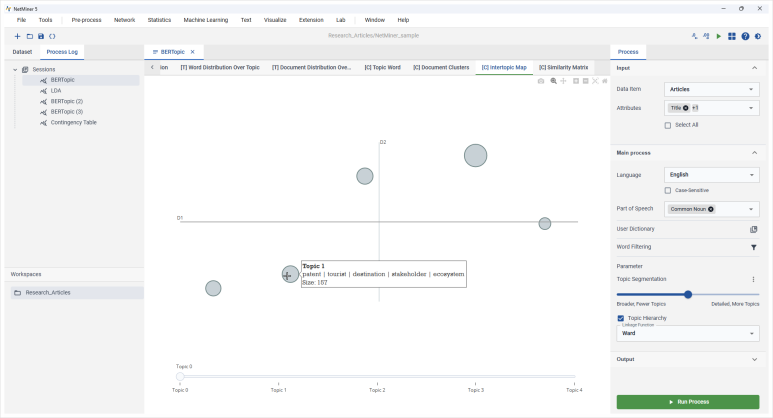
Intertopic Map(Topic Distance Map) (Left) and Similarity Matrix (Right)

Representative Keywords by Topic
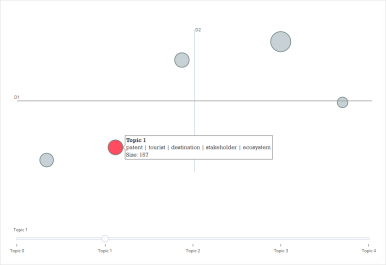
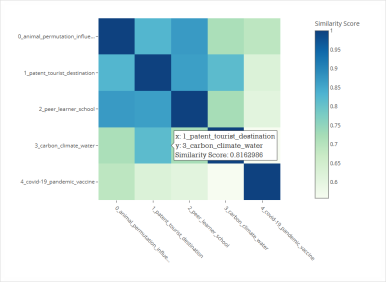
Why BERTopic Is Gaining Attention
There is no single “correct” way to find topics in text data.
Depending on the nature of the data and the purpose of analysis, you might choose statistical approaches such as LDA or K-Means, or network-based techniques like community detection.
Among these, BERTopic stands out because it considers context and meaning. Unlike traditional topic models that rely only on word frequency, BERTopic captures semantic relationships and contextual nuances within sentences. As a result, for data such as political discourse, social issues, or public opinion—where expression varies and tone matters— BERTopic can uncover more refined and realistic topic structures than frequency-based methods. Thanks to these strengths, the number of research papers applying BERTopic has grown rapidly over the past three years.

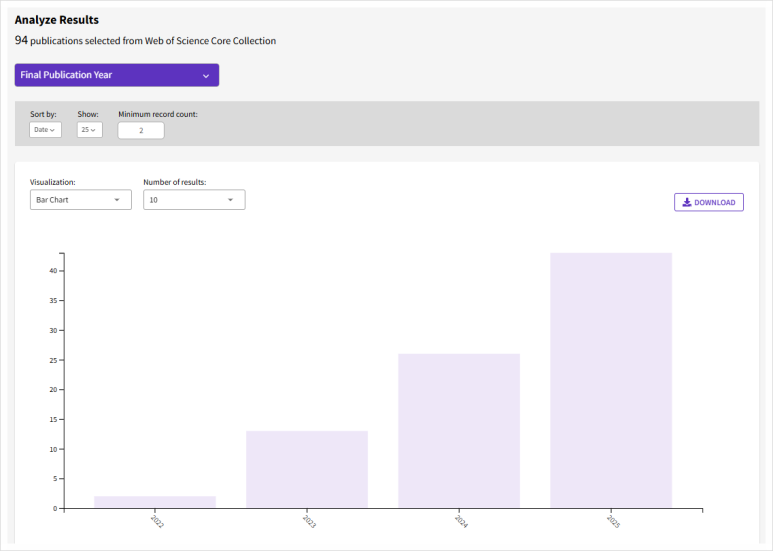
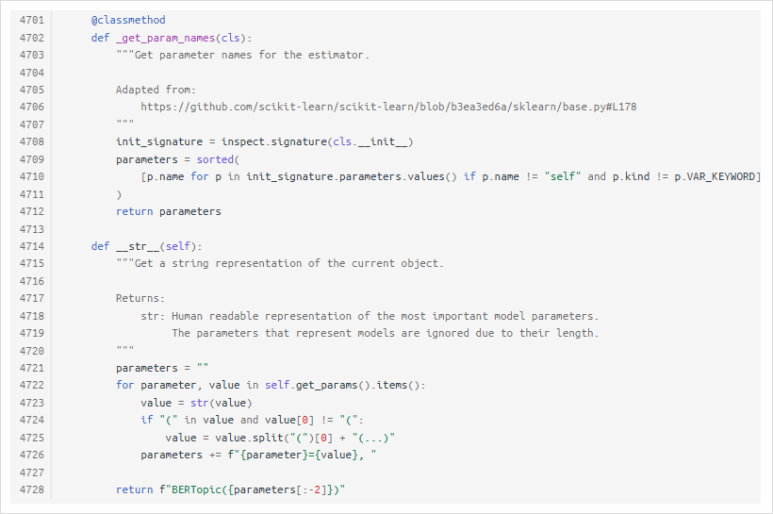
Until recently, using BERTopic required a programming environment such as R or Python - including installing packages, preprocessing data, tuning parameters, and saving results manually. This made the method powerful yet difficult for non-programmers to access.

Now, however, NetMiner allows you to run BERTopic entirely through a no-code GUI environment. From data selection and preprocessing to parameter configuration, topic visualization, and exploring relationships between topics — everything can be done with just a few clicks. This means anyone can now explore the flow and meaning of topics within their data, without writing a single line of code.

Conclusion
Text data is no longer just a collection of words — it has become an essential resource for understanding society and complex phenomena. BERTopic helps you grasp topics through the “meaning” of language and visualize the “structure of stories” hidden within your data. Want to see how topics emerge, evolve, and connect — all at a glance? Experience BERTopic directly in NetMiner 5, no coding required.
"In addition to the expected outcomes (i.e.,topics), BERTopic was able to generate novel insights using its embedding approach"
Egger, R., & Yu, J. (2022). A topic modeling comparison between LDA, NMF, Top2Vec, and BERTopic to demystify Twitter posts. Frontiers in Sociology, 7, Article 886498. https://doi.org/10.3389/fsoc.2022.886498