Where Is the Latest AI Research Headed? Core AI Keywords and Major Topics from International Papers
In the previous session, we explored the key keywords in AI-related research papers by analyzing word frequency and TF-IDF values. We also identified the most prominent collaborators through co-authorship network analysis and examined which research fields showed the most active author participation.
In this session, we will apply topic modeling to uncover the core themes and research clusters within AI studies. Additionally, we will visualize the relational structure of terms by constructing a co-occurrence word network, allowing us to identify which keywords occupy central positions within the network.
Section 1. What are the Key Keywords in AI Research Papers?
※ Before diving into analysis, start with this essential data collection step:
☞ Where Is the Latest AI Research Headed? Analyzing Key Researchers from 1,000 International Papers
A. Checking Word Frequency and TF-IDF Values
As in the previous session, we will use the Word Statistics function to examine word frequency and TF-IDF values. This time, we will also include the results after applying a user dictionary.
Go to Text > Word Statistics.
In the Input control items, select the recently imported dataset and the attribute that contains the text.
In Main Process, choose the language of the text and the part of speech to extract (e.g., English, Common Noun, Proper Noun).
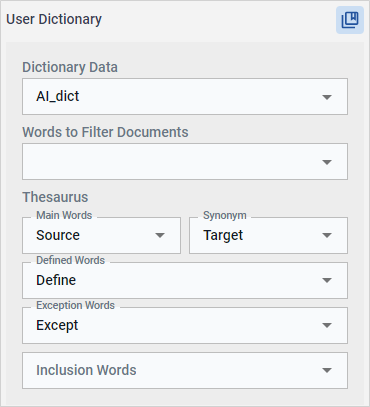
In User Dictionary, select the column for the user-defined dictionary to be applied during preprocessing.
For more information on user dictionaries, refer to the 'Filtering Documents and Selecting a Dictionary' section in the NetMiner 5 manual.
Click the Run Process button to execute the analysis.
In the [T]Words tab, click the Total Frequency or Average TF-IDF column to sort the values in descending or ascending order.
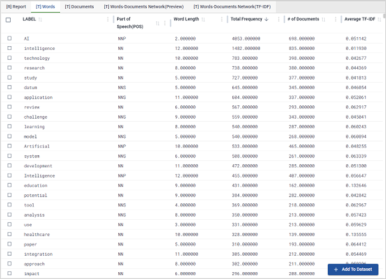
Total Frequency |
Average TF-IDF |
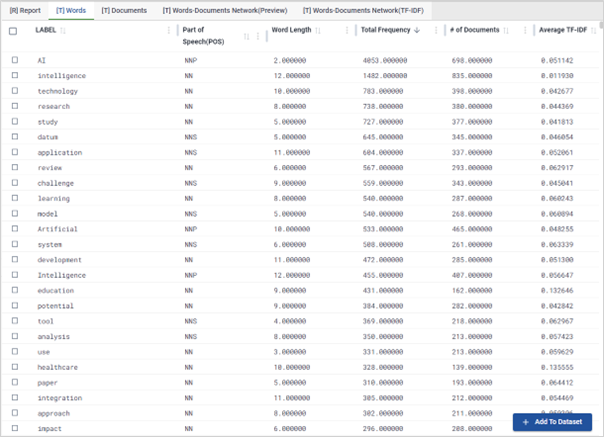
After analyzing 1,000 research papers, the most frequently used words included 'study', 'application', 'Machine Learning', 'challenge', 'education', 'potential', 'Healthcare', 'literature', 'Chatgpt', 'patient'.
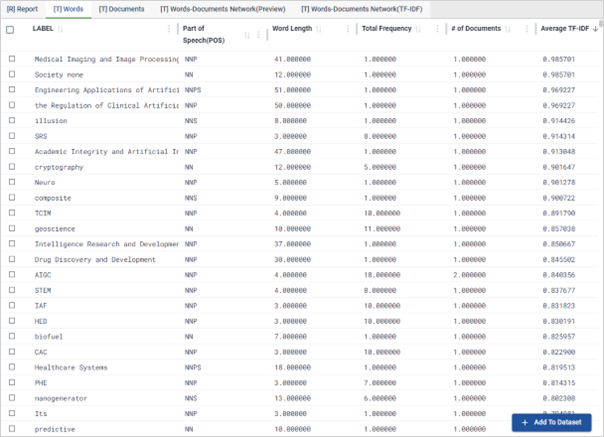
On the other hand, based on average TF-IDF values, the most significant words 'Neuro', 'Society', 'biofuel', 'illusion', 'cryptography', 'TCIM', 'SRS', 'geoscience', 'Drug Discovery and Development', 'nanogenerator', 'greenwashing', 'Endodontic', 'Brain', 'biosensing'.
When sorting by word frequency, the results mostly reflected terms related to AI technologies. In contrast, when sorting by TF-IDF values, the highlighted terms were more closely associated with specific academic fields where AI is being applied.
Click Add To Dataset > Text Network Items at the bottom, then click OK. You will see that a new nodeset and network, generated through preprocessing, appear in the left panel.
Section 2. What AI Research Topics Are International Researchers Focusing On?
Using LDA Topic Modeling, we will explore the major themes found AI-related research papers authored by international researchers.
A. Topic Evaluation
Before performing topic modeling, it is important to determine the most appropriate number of topics.
Go to Text > Topic > Topic Evaluation
In the Input panel on the right, select the Documents dataset and the text column that contains the content to be analyzed.
Choose the language and part of speech to apply in the analysis.
Register a user dictionary.
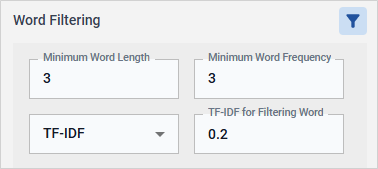
Enter Word Filtering conditions.
In this case, we will filter for words that are 3 characters or more, appear at least 3 times, and have a TF-IDF value of 0.2 or higher
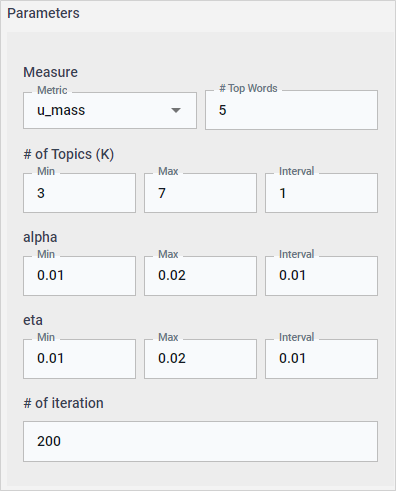
Set the parameter values.
Measure: Select the coherence calculation method (e.g., c_v, u_mass).
# of Topics (K): Specify the range for the number of topics토픽 수의 범위를 지정합니다.
alpha (α): Enter the range for the topic distribution probability within documents.
eta (β): Set the range for the prior probability distribution of word assignments per topic.
# of Iterations: Define the number of iterations to run for each LDA model.
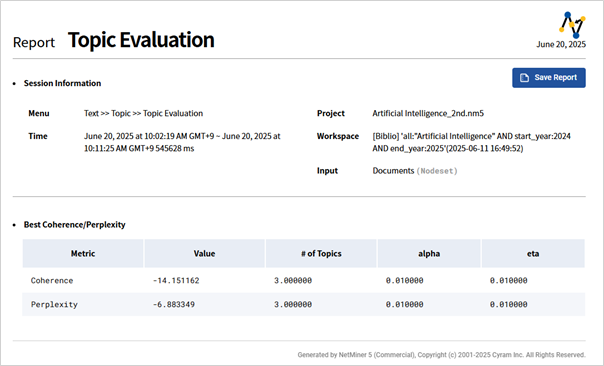
Click the Run Process button to generate the optimal number of topics along with the most appropriate values for alpha and eta.
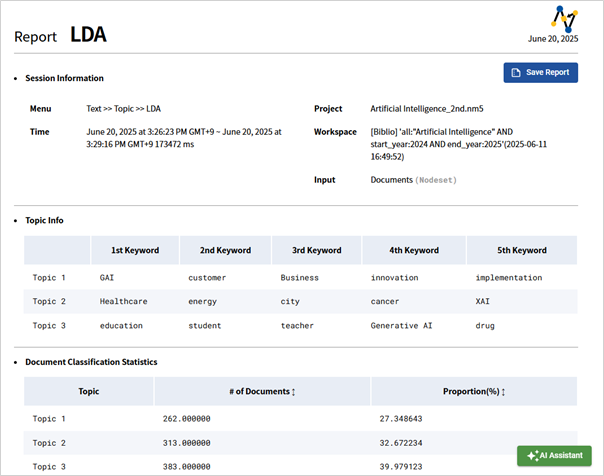
Based on the Topic Evaluation results, a 3-topic model with alpha = 0.01 and eta = 0.01 was determined to be the most suitable parameter setting.
B. LDA Topic Modeling
Go to Text > Topic > LDA
As in Topic Evaluation, specify the Documents dataset, the text column to be analyzed, the language and part of speech, register a user dictionary, and set the word filtering conditions.
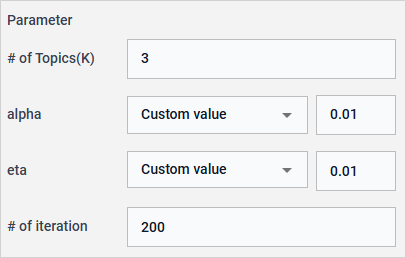
Enter the parameter values identified during the Topic Evaluation step.
The topic modeling analysis has been completed.
Section 3. How are AI Research Keywords Connected?
To explore the relationships between words used in AI research papers, we will generate and visualize a co-occurence word network.
Co-occurence word network analysis examines how terms that appear together in research texts (e.g., title, abstracts etc.) are related. This method helps identify key research domains or subtopics, understand how specific concepts are linked to others, determine which words occupy central positions in the network, and uncover emerging research areas or interdisciplinary trends.
A. Work Network
There are two common methods for constructing co-occurrence word networks:
1. Sliding Window, which considers word proximity.
2. Co-occurence, which focuses on words appearing in the same context or document.
In this session, we will use the Sliding Window method to generate a co-occurence word network.
Go to Pre-process > Text > Word Network > Sliding Window
Select the Documents dataset, the Text column to analyze, set the language and part of speech, and register a user dictionary.
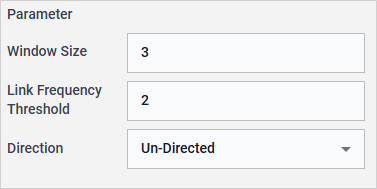
Set the following parameters:
widow size: Number of neighboring words to consider for link creation
Link Frequency Threshold: Minimum number of co-occurrences required to form a link
Direction(Directed / Un-Directed): Whether to include directionality in the links
In [T]Word Network, you can view the word co-occurrence network in the form of an edge list.
Click the Add To Dataset > Text Network Items button at the bottom right of the result table.
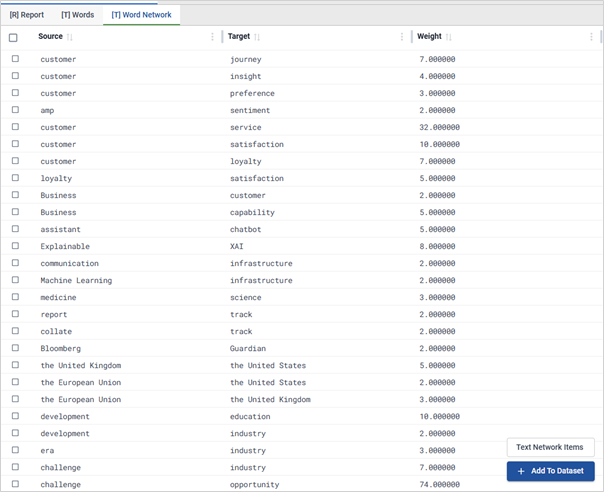
Make sure that Word and Word Network are selected, then click OK. The word co-occurrence network has now been added as a new nodeset and network.
B. Filtering Out Unnecessary Words
To exclude isolate word nodes from the analysis, a preprocessing step is required.
Go to Network > Neightbor > Degree
In the 1-mode Network, select Word Network and check Use Weight, then Run Process.
In the [T]Node Type tab, click Add To Dataset > Node Attribute.
Make sure Node Type is selected, then click OK. The Node Type is now added as a new attribute to the Word nodeset.
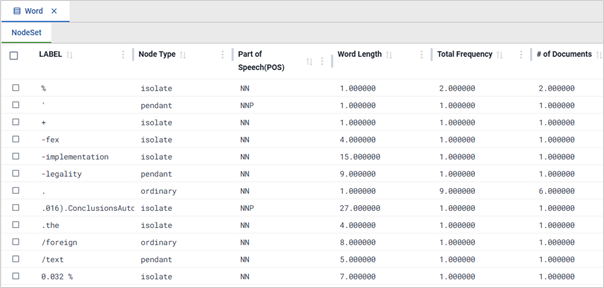
Words with the Node Type "isolate" represent isolated nodes that are not connected to any other words. Since these are not useful for analysis, we will exclude them using Query.
Go to Tools > Query
In Select Dataset, choose the Word nodeset.
We will filter to include only words that are not isolated, and that have a word length and frequency of 3 or more.
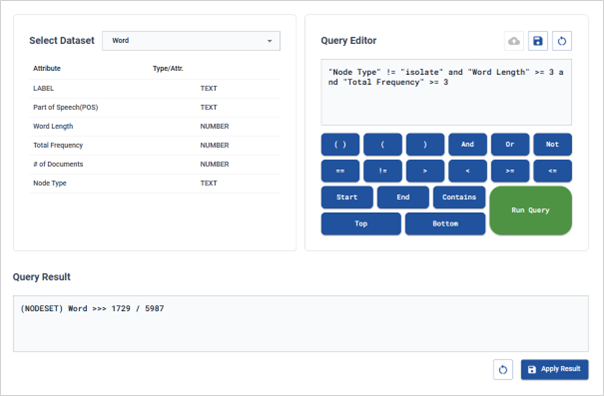
Out of 5,987 words, 1,729 words were filtered based on the conditions.
Click the Apply Result button to generate a new nodeset and network in a separate workspace.
C. Adding Centrality Anaylsis Results as Attributed to the Word Nodeset
Go to Network > Centrality > Degree Centrality
In the Input control panel on the right, select the Word Network and check Use Weight, then click the Run Process button.
In the [T]Degree Centrality tab, click Add to Dataset > Node Attribute.
Make sure both In-Degree Centrality and Out-Degree Centrality are selected, then click OK. The centrality values are now added as new attributes to the Word nodeset.
D. Visualizing the Word Network
Go to Visualize > Network > 1-mode.
In the control panel on the right, click the Style tab
Adjust Node Size: In the Node tab, click the size icon next to the Size field. Select the recently added In-Degree Centrality. Nodes with higher centrality values will appear larger.
Adjust Link Width: In the Link tab, click the line icon next to the Width field. Select WEIGHT to make links appear thicker as their weight increases.
By visualizing the size of nodes based on centrality, we can clearly identify which keywords play a central role in connecting research topics and concepts in AI. Larger nodes represent more central, influential terms within the network.
In addition, thicker links indicate stronger co-occurrence between two words, suggesting that those word pairs are conceptually related and frequently discussed together in the same topic or context within AI research.

Section 4. Complex Analysis, Simplified - Key insights from the AI Assistant!
Now, let’s see how the AI Assistant interprets the results of the word network analysis we've conducted so far.
A. Interpretation of LDA
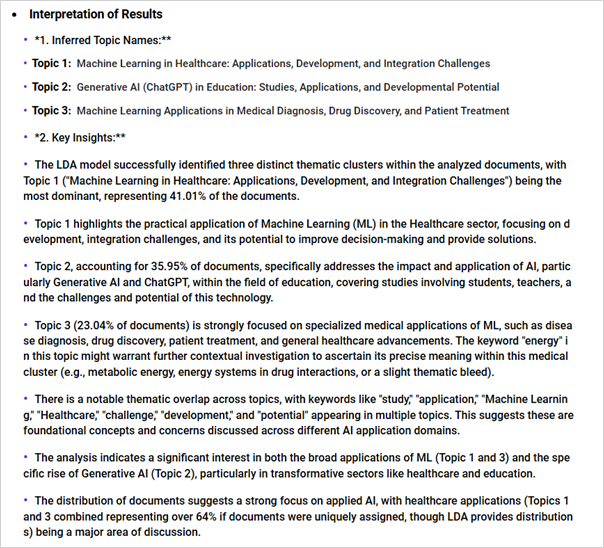
AI interpreted the results as showing that research related to artificial intelligence is particularly active in the fields of healthcare, education, and medicine.
Topic 1 was classified as relating to the healthcare sector, where machine learning technologies are being applied in the industry. The topic includes discussions on challenges in the development process, potential applications, integration strategies, and decision-support systems.
Topic 2 was interpreted as focusing on the education field, highlighting how generative AI models like ChatGPT can be applied in educational settings and what potential impacts they may have.
Topic 3 was associated with the medical field, particularly addressing how machine learning is being used in disease diagnosis, drug development, and patient treatment. The topic emphasizes specific use cases and ongoing research in medical AI applications.
B. Interpretation of Degree Centrality Analysis Results

And if you save the [T] Topic info as a 2-mode network, you can visualize the topics and key terms as a network map, as shown below.
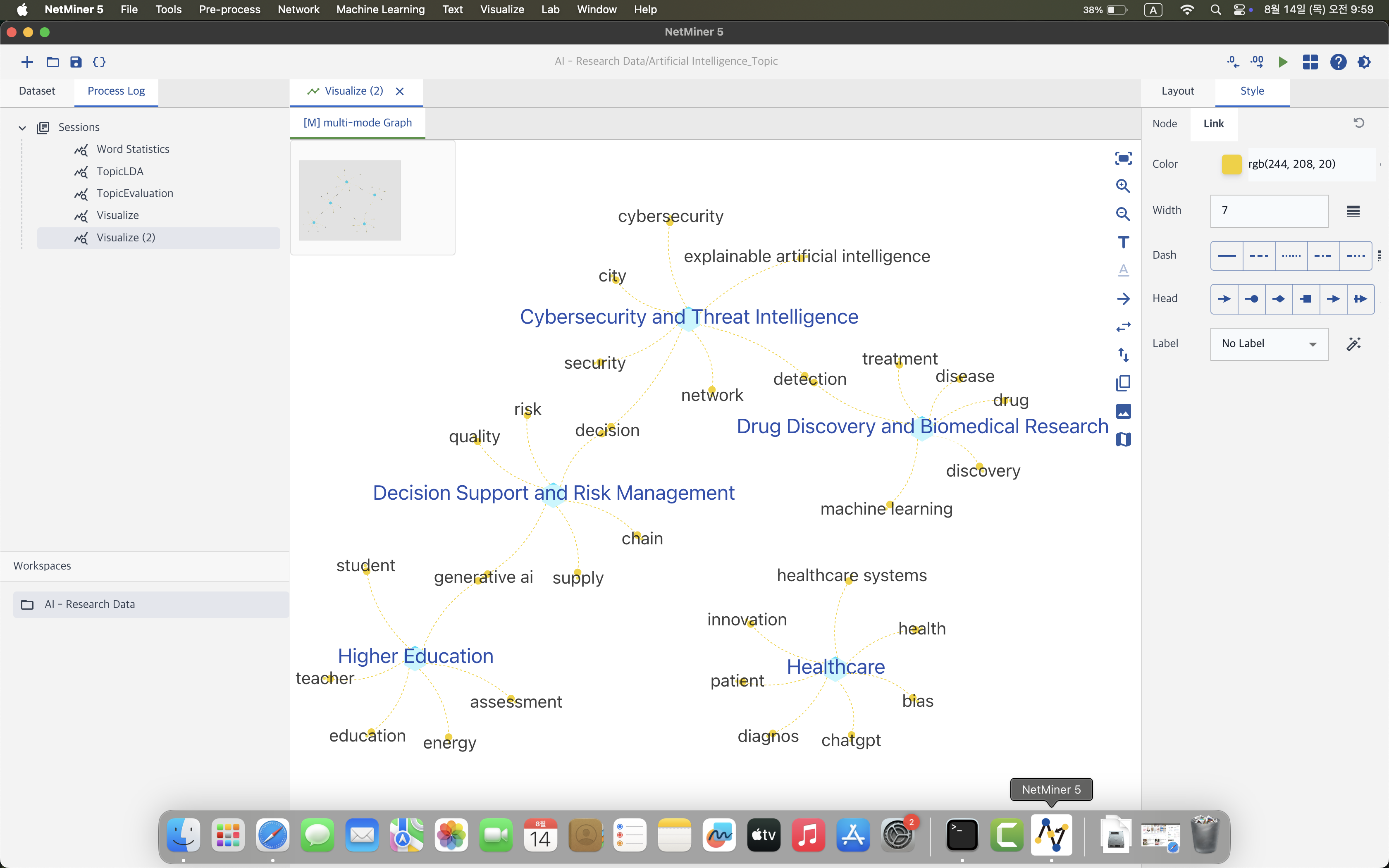
Based on the results of the degree centrality analysis, AI identified that key application areas and core technology keywords such as Healthcare, Machine Learning, and Education showed high centrality values.
This suggests that these fields and technologies are central topics of interest and active areas of research within the broader AI domain.
Additionally, words representing more specific techniques—such as detection, diagnosis, and Deep Learning—also exhibited high centrality, indicating that deep learning is being actively utilized in detection and diagnostic applications.
The AI Assistant also recommended exploring additional analytical approaches, such as community detection and other centrality measures, to help researchers gain deeper insights into the structure and dynamics of the keyword network.
With NetMiner 5 and the Biblio Data Collector, you've completed the process of collecting, analyzing, visualizing bibliographic data, and interpreting results using AI to explore research trends.
Now it's your turn — discover new insights by analyzing your own data with NetMiner 5!
※ Related Tutorial
☞Where Is the Latest AI Research Headed? Analyzing Key Researchers from 1,000 International Papers