Graph Machine Learning, Exploring the Future
Data is not just about quantity — it challenges us on an entirely new dimension of structural complexity. Concepts such as relationships, connections, and flows, which cannot be fully captured through simple numerical summaries or tables, demand new ways of analysis. This is why we need to reframe our view of data through graph and network analysis. Recently, by combining graph analysis with AI technologies, we are entering a new phase called Graph Intelligence, which has emerged as a critical element in data-driven decision-making.
Why Graphs Matter?
Graph Analytics and Social Network Analysis are methodologies based on data structures composed of nodes (entities) and links (relationships, edges).


Originally developed within sociology in the early 20th century, Social Network Analysis has become an essential tool across various fields as relational data has exploded with the rise of online platforms and digital technologies. Graph analysis provides the only and essential method to understand the structure of connections, something that traditional data analysis methods struggle to capture. Furthermore, with the limitations of traditional machine learning and deep learning models that typically treat each data point as independent, Graph Neural Networks (GNNs) offers a breakthrough by modeling complex relationships and interactions between entities. There is also a growing need across research and industry to understand graphs at a higher level—integrating not just structural connections, but also behavior, cognition, and context of the actors involved. This reflects an increasing demand to interpret relationship-based data and transform it into predictable, actionable structures.
Graph analytics and decision intelligence are essential finance capabilities to do this
: graph analytics reveal the narrative clusters of data points and the relationships between them.
Gartner (2024) Gartner CFO & Finance Executive Conference Sydney: Day 1 Highlights.
Retrieved from https://www.gartner.com/en/newsroom/press-releases
Key Trends Driving Graph Intelligence
1. Graph Neural Networks (GNN): Learning on Graphs
Traditional machine learning models primarily rely on individual entity features (attributes) without adequately addressing structural relationships. For example, when predicting customer churn, traditional models might only use demographic and usage data. However, in reality, a customer's interactions — who they connect with, and how — play a critical role in churn behavior. GNNs were developed to address this limitation. They operate on the key idea that "my characteristics are influenced by my neighbors’ characteristics", enabling deep-learning models to learn both node features and network structure simultaneously.
GNNs have seen explosive growth in academic research and applications over the past decade, demonstrating their powerful expressiveness and predictive capabilities, particularly for complex, interaction-heavy datasets.
* Example GNN algorithms: GCN (Graph Convolutional Network), GAT (Graph Attention Network), GraphSAGE
<Frequency of related terms in books>

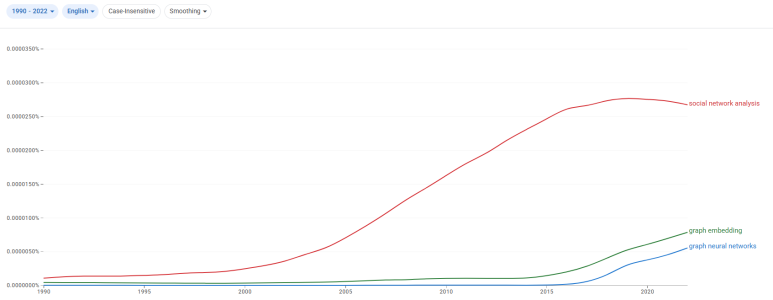
※Source: Google Books Ngram Viewer
GNNs (Graph Neural Networks) are highly effective in addressing relationship-based problems such as node classification, link prediction, and graph classification,
and demonstrate superior expressiveness and predictive performance, particularly for datasets characterized by complex structures and interactions.
① Node-Level Tasks: Node Classification and Node Attribute Prediction
First, GNNs can be utilized to cluster similar nodes (classification) or predict missing node attributes based on the similarity of node features and relational structures. For example, in social media, it is possible to predict a user's political inclination based on the political tendencies of other users they are connected to.
Additionally, GNNs can be applied to enhance classification in other domains, such as:
- Classifying web pages into more refined semantic categories by leveraging hyperlink structures - Classifying research papers or academic documents by analyzing their citation networks Furthermore, a methodology has been explored where GNNs are first used to assign labels to unlabeled data, and traditional machine learning techniques are then applied for further analysis.
② Link-Level Tasks: Link Prediction
Link prediction refers to the task of predicting potential connections between two nodes — one of the most important challenges in network data analysis. By predicting relationships between nodes, it becomes possible to: - Complete and enrich existing network structures, and
- Anticipate future states or enhance recommendation systems. Examples of link prediction applications include: - Recommending content, products, or information to users on platforms such as Netflix and Pinterest - Detecting potential terrorist networks - Enhancing knowledge graphs - Friend recommendation systems in social media platforms
③ Graph-Level Tasks: Graph Classification
Graph classification focuses on predicting the properties of entire graphs or classifying graphs with similar structures. Through graph embedding, the overall information contained in a graph can be compressed and summarized, and then combined with other types of graph-level information for purposes such as new attribute prediction, classification, or recommendation. For instance, one can train a model on the structural graphs of molecular compounds that are known to be effective against certain diseases, and subsequently predict whether other molecular structures might also be effective for the same disease.
GNNs are no longer confined to theoretical exploration. They have become real-world solutions across industries, including UberEats' recommendation system[1], Pinterest’s PinSage model[2], biomedical research, traffic prediction, and more.
<Applications of GNNs>
※ Source: Zhou, Jie & Cui, Ganqu & Zhang, Zhengyan & Yang, Cheng & Liu, Zhiyuan & Sun, Maosong. (2018).
Graph Neural Networks: A Review of Methods and Applications. 10.48550/arXiv.1812.08434.
2. Graph Embedding: Transforming Graphs into Learnable Vectors
Most traditional machine learning algorithms expect inputs as feature vectors. However, graph data, composed of node-link matrices, is inherently high-dimensional and computationally intensive to process. Graph Embedding addresses this challenge by mapping the structural information of graphs into lower-dimensional vectors, preserving proximity and similarity within the embedding space.
Graph embeddings make it possible to apply machine learning and deep learning techniques to graph-structured data efficiently.
3. Explainable AI for Graphs: Making Predictions Interpretable
Deep learning models often operate as black boxes, making it difficult to understand how or why predictions were made. This issue is even more critical in graph models, where not just individual nodes, but entire substructures (e.g., communities, paths, subgraphs) can significantly impact outcomes.
Graph Explainability (Graph XAI) methods, such as: - GNNExplainer - PGExplainer - Subgraph extraction and link importance simulation ...aim to identify and explain which parts of the graph contributed most to a prediction. Graph XAI is essential for building trust and insight into graph-based AI systems.
Graph and network analysis offer the most faithful model to reflect the complexity of the real world.
They provide a way to structurally understand the world and transform that understanding into predictable, actionable intelligence. Today, GNNs and various graph-based models are rapidly advancing. With growing integration across different data types and analytical methodologies, the role of Graph Intelligence is set to become even more critical in our increasingly interconnected and complex world.
Building a fully operational Graph Intelligence environment traditionally demands substantial time, expertise, and effort.
We're preparing a major upgrade to support Graph Machine Learning workflows in next-generation version of NetMiner.
Without the need for extensive additional learning, NetMiner will offer optimized algorithms, pipelines, and a user-friendly UI/UX that allow anyone to easily and intuitively perform graph machine learning.
You’ll soon be able to directly experience how we bring advanced graph intelligence capabilities into the hands of all users.
Interpreting complex data structures. Predicting the future with precision. Now is the time to focus on Graph Intelligence.
Related Article: Examples of Graph Machine Learning
Finance: Credit Scoring
Cybersecurity: Malware Detection
Transportation: Traffic Prediction
HR/Organization: Managerial Role Suitability Prediction
Business: Startup Follow-up Investment Prediction
Healthcare: Cancer Prognosis Gene Prediction
Social Media: User Classification
Criminal Justice: Recidivism Prediction
Text Analysis: Text Classification
Reference
[1] Uber Blog (2019). Food Discovery with Uber Eats: Using Graph Learning to Power Recommendations
[2] Pinterest Engineering Blog(Medium) (2018). PinSage: A new graph convolutional neural network for web-scale recommender systems
[3] MIT News (2025). Could LLMs help design our next medicines and materials?